
Floral Wire Gauge Chart: Which Gauge Should Florists Use?
Floral wire looks simple until you're standing at the workbench deciding whether you need 18, 20, 22 or 24 gauge.
The most important rule is easy to remember:
Floral wire gauge works in reverse: the lower the gauge number, the thicker and sturdier the wire. The higher the gauge number, the thinner and more flexible the wire.
So among four common florist-wire sizes, 18 gauge is the strongest and stiffest, while 24 gauge is the lightest and most flexible.
The goal isn't to automatically reach for the heaviest wire. Good floral mechanics use enough support for the design while keeping the wire as light, workable and easy to conceal as practical.
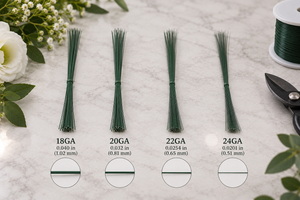
Floral Wire Gauge Chart
| Gauge | Approx. AWG Diameter | Relative Strength | Flexibility | Good Starting Point For |
|---|---|---|---|---|
| 18 gauge | 1.02 mm / 0.0403" | Heavy-duty | Lowest of these four | Heavy stems, large flowers, structural mechanics, florist netting, wreaths and sympathy work |
| 20 gauge | 0.81 mm / 0.0320" | Strong | Moderate | Medium-to-large flowers, stem support, wreaths, bows, centerpieces and foam mechanics |
| 22 gauge | 0.64 mm / 0.0253" | Medium / all-purpose | Flexible | General flower wiring, bows, wreaths, lighter stem support, corsages and boutonnieres |
| 24 gauge | 0.51 mm / 0.0201" | Light | Most flexible of these four | Delicate flowers, foliage, corsages, boutonnieres, small accents and detailed mechanics |
Diameter note: The measurements above are American Wire Gauge (AWG) reference diameters. Floral wire may be manufactured using a different gauge standard or manufacturer specification, so these measurements should be treated as reference values unless the manufacturer specifically confirms AWG dimensions.
Shop professional florist wire at L.O. Florist Supplies.
How Does Floral Wire Gauge Work?
Wire gauge measures wire thickness, but the numbering can feel backward if you haven't worked with it before.
An 18-gauge wire is thicker than a 20-gauge wire. A 20-gauge wire is thicker than a 22-gauge wire. And a 22-gauge wire is thicker than a 24-gauge wire.
As the gauge number increases, the wire becomes thinner and generally easier to bend and manipulate. As the number decreases, the wire becomes sturdier and better suited to heavier loads and structural mechanics.
Using standard American Wire Gauge measurements as a reference, 18 AWG is approximately 1.02 mm in diameter, 20 AWG is approximately 0.81 mm, 22 AWG is approximately 0.64 mm and 24 AWG is approximately 0.51 mm.
That difference may sound small on paper, but it is significant in practice. An 18-gauge wire contains substantially more metal than a 24-gauge wire and therefore behaves very differently when supporting stems, wreath mechanics or other floral structures.
One technical detail is worth remembering: not every florist-wire product necessarily follows American Wire Gauge specifications. Different manufacturers and wire-gauge standards can produce different actual diameters for the same labeled gauge. If exact diameter is important for a project, use the manufacturer's specification for the particular wire rather than assuming every gauge chart applies universally.
What Is 18 Gauge Floral Wire Used For?
18 gauge is the heavy-duty option in L.O.'s core straight-wire range.
Use 18-gauge florist wire when the wire is performing a real structural job rather than simply helping position a lightweight stem.
Common applications include:
- Heavy or substantial stems
- Large flowers
- Stem reinforcement
- Securing floral foam or other mechanics
- Binding florist netting
- Wreath construction
- Sympathy arrangements
- Other structural floral mechanics
For designs carrying meaningful weight or requiring greater stiffness, 18 gauge provides more structural support than the lighter gauges below it.
As an AWG reference, 18 gauge measures approximately 1.02 mm or 0.0403 inches in diameter.
Shop 18" Green Coated Florist Wire — 18 Gauge, 12 lb. Box
What Is 20 Gauge Floral Wire Used For?
For a working flower shop, 20 gauge occupies a useful middle ground between heavy structural wire and lighter detail wire.
It works well for medium-to-large flowers, fresh-flower stem support, wreaths, bows, floral-foam mechanics, centerpieces and general floral design.
It is stronger than 22 or 24 gauge while remaining easier to manipulate than heavier 18-gauge wire.
If a florist wants more support than a lighter all-purpose wire provides but doesn't need the stiffness of 18 gauge, 20 gauge is a practical choice.
It is especially useful in shops producing a mixture of everyday work, weddings, wreaths and larger arrangements rather than specializing only in small personal flowers.
As an AWG reference, 20 gauge measures approximately 0.81 mm or 0.0320 inches in diameter.
Shop 18" Green Coated Florist Wire — 20 Gauge, 12 lb. Box
What Is 22 Gauge Floral Wire Used For?
If you're looking for an all-purpose florist wire, 22 gauge deserves particular attention.
It provides enough support for many common floral tasks while remaining easy to bend and manipulate.
Typical uses include:
- General flower wiring
- Light stem support
- Wreath work
- Bows
- Artificial flowers
- Corsages
- Boutonnieres
- Everyday flower-shop production
That balance makes 22 gauge a versatile shop staple.
For many everyday flower-wiring jobs, it provides a useful starting point. Move down to 20 or 18 gauge when a design needs greater strength, or move up to 24 gauge when delicacy and flexibility matter more.
As an AWG reference, 22 gauge measures approximately 0.64 mm or 0.0253 inches in diameter.
Shop 18" Green Coated Florist Wire — 22 Gauge, 12 lb. Box
What Is 24 Gauge Floral Wire Used For?
24 gauge is the lightest and most flexible of the four straight-wire gauges in this comparison.
It is particularly useful for delicate flowers, lightweight stems, foliage, corsages, boutonnieres, artificial flowers, small accents and detailed floral mechanics.
This is where flexibility becomes an advantage.
Personal flowers and detailed design work often need mechanics that can be positioned precisely without adding unnecessary visual or physical bulk. A heavier wire might technically hold the material, but that doesn't mean it is the best wire for the job.
As an AWG reference, 24 gauge measures approximately 0.51 mm or 0.0201 inches in diameter.
Shop 18" Green Coated Florist Wire — 24 Gauge, 12 lb. Box
18 vs. 20 vs. 22 vs. 24 Gauge: Which Should You Choose?
A useful way to choose is to start with the job the wire needs to perform rather than the flower alone.
- Choose 18 gauge when the wire needs to carry substantial weight or reinforce structural mechanics.
- Choose 20 gauge for strong general support for medium-to-large stems or floral mechanics.
- Choose 22 gauge for versatile everyday flower-shop wiring.
- Choose 24 gauge for corsages, boutonnieres, delicate wired flowers, foliage and detail work.
If a lighter wire doesn't adequately support the material, step down to a lower gauge number and therefore a thicker wire.
There isn't one universal “best floral wire.” The correct gauge is the one that gives the design enough mechanical support without introducing more wire than the work requires.
Why Does a 12-Pound Box Contain Different Numbers of Wires?
This is an easy detail to overlook when comparing bulk florist wire.
The boxes may weigh the same, but thicker wire weighs more per piece, so heavier gauges contain fewer individual wires.
L.O.'s 18-inch bulk boxes contain approximately:
| Gauge | Length | Approximate Pieces per 12-lb. Box |
|---|---|---|
| 18 gauge | 18" | 1,200 |
| 20 gauge | 18" | 2,400 |
| 22 gauge | 18" | 4,000 |
| 24 gauge | 18" | 6,000 |
These are approximate counts rather than guaranteed piece quantities because the products are sold by bulk weight.
For professional flower shops, that distinction matters when estimating consumption and purchasing supplies for seasonal production.
For example, a 12-pound box of 24-gauge wire contains roughly five times as many individual pieces as the same-weight box of 18-gauge wire—not because one is inherently a better value, but because each 24-gauge piece uses substantially less metal.
Straight Floral Wire vs. Paddle Wire vs. Spool Wire
Gauge isn't the only decision. The format of the wire matters too.
Straight or cut florist wire comes in predetermined lengths. L.O.'s core range is cut to 18 inches, making it convenient for individual stem reinforcement, flower wiring and mechanics where a ready-to-use straight piece is helpful.
Paddle or spool wire provides a continuous length. It is particularly useful when wrapping, binding or attaching materials around wreaths, forms and other mechanics.
Bind wire is another specialty option used for applications such as wreath construction, orchid work and structural floral mechanics.
A well-equipped professional workroom may therefore stock multiple gauges and formats rather than expecting one wire to perform every job.
Do Professional Florists Need More Than One Wire Gauge?
For most full-service flower shops, yes.
A shop producing everyday arrangements, weddings, funeral work, wreaths, corsages and event pieces encounters very different mechanical demands.
A practical core inventory is:
18 gauge for heavy support → 20 gauge for stronger everyday mechanics → 22 gauge for versatile general work → 24 gauge for lighter and more detailed work.
You won't necessarily use every gauge every day. The value is having the appropriate degree of support available when the design changes.
Frequently Asked Questions About Floral Wire Gauge
Is 18 gauge or 24 gauge floral wire thicker?
18 gauge is thicker. Floral wire numbering runs in reverse: lower gauge numbers indicate thicker wire, while higher gauge numbers indicate thinner wire.
What is the best general-purpose floral wire gauge?
For L.O.'s straight-wire range, 22 gauge is a useful all-purpose starting point because it combines practical support with easy manipulation. For work requiring additional strength, move to 20 gauge.
What gauge floral wire should I use for corsages and boutonnieres?
For lightweight or delicate personal-flower work, 24 gauge is a strong starting point because of its flexibility and reduced bulk. A 22-gauge wire can be used when additional support is necessary.
What gauge floral wire is best for heavy stems?
Start toward 18 or 20 gauge when substantial support is required. Eighteen gauge provides greater stiffness for heavy stems and structural mechanics, while 20 gauge provides strong support with somewhat greater flexibility.
How thick is 18 gauge floral wire?
Using American Wire Gauge as a reference, 18 AWG is approximately 1.02 mm or 0.0403 inches in diameter. Actual floral-wire diameter can vary if a manufacturer uses a different gauge standard.
How thick is 20 gauge floral wire?
Using American Wire Gauge as a reference, 20 AWG is approximately 0.81 mm or 0.0320 inches in diameter. Manufacturer specifications should be used when exact diameter is required.
How thick is 22 gauge floral wire?
Using American Wire Gauge as a reference, 22 AWG is approximately 0.64 mm or 0.0253 inches in diameter.
How thick is 24 gauge floral wire?
Using American Wire Gauge as a reference, 24 AWG is approximately 0.51 mm or 0.0201 inches in diameter.
How many pieces of florist wire are in a 12-pound box?
The approximate count depends heavily on the gauge. L.O.'s current 18-inch bulk boxes contain approximately 1,200 pieces at 18 gauge, 2,400 at 20 gauge, 4,000 at 22 gauge and 6,000 at 24 gauge.
Stock the Right Floral Wire for Every Design
Professional florists rarely make just one kind of arrangement, which is why floral wire shouldn't be treated as a one-size-fits-all supply.
Keep heavier gauges available for support and mechanics, versatile middle gauges for daily production, and flexible lighter wire for personal flowers and detail work.
Matching the wire to the design makes mechanics easier to build, easier to conceal and better suited to the job they're actually being asked to perform.
L.O. Florist Supplies stocks straight florist wire, spool wire, bind wire, florist netting and other professional floral mechanics for flower shops, event designers and production workrooms.
Working on arrangements that combine wire with floral foam? Read our OASIS floral foam selection guide or browse our professional wet floral foam for additional flower-shop mechanics.
Recent Posts
-
Floral Wire Gauge Chart: Which Gauge Should Florists Use?
Floral wire looks simple until you're standing at the workbench deciding whether you need 18, 20, 22 … -

Which OASIS Floral Foam Should You Use? A Florist’s Guide to Advantage Plus, Standard, Instant & Deluxe
Walk into almost any professional flower shop and someone will eventually ask for “Oasis.” But OASIS … -
Enhancing Freshness and Sustainability with Chrysal Arrive Alive® Eco
In the world of floristry, ensuring the freshness and longevity of flowers during transport is a cri …